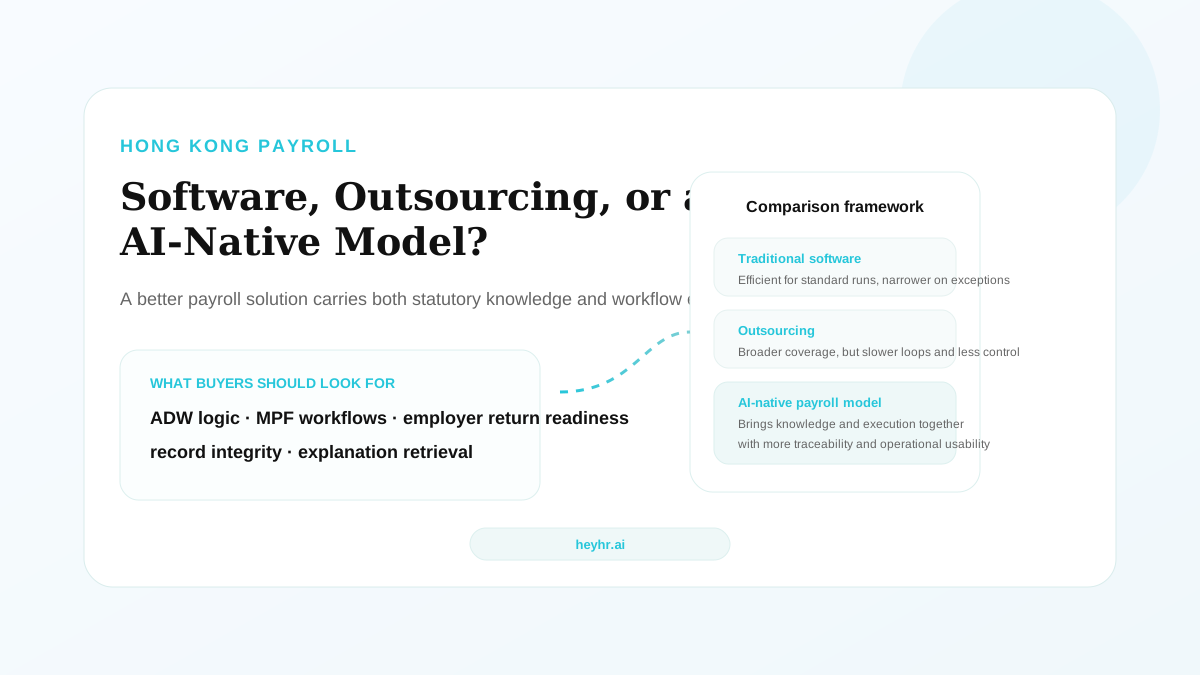
- The real issue in Hong Kong payroll is not just calculation. It is whether statutory knowledge and workflow execution stay together.
- Traditional software often automates the standard monthly run but leaves the hard exceptions outside the system.
- Outsourcing covers more real-world execution, but often through service queues, repeated clarification, and weaker visibility.
- An AI-native payroll model matters when it helps encode knowledge-heavy payroll work while keeping outcomes reviewable and operationally usable.
When companies in Hong Kong evaluate payroll, the options usually appear simple: use payroll software, outsource payroll, or continue to manage the process internally. But that framing hides the real issue. The hard part of payroll is not only calculation. It is the combination of statutory knowledge and workflow execution — knowing which rules apply, and being able to run them consistently through payroll operations.
That is exactly why the category feels unsatisfying today. Traditional software often automates the routine monthly run, yet leaves the knowledge-heavy exceptions outside the system. Outsourcing can cover more of the real operational scope, but it often does so through people, service queues, repeated communication, and fragmented handoffs. In other words, the supposedly more advanced option can end up covering less of the real payroll burden than a manual service model.
This has created a long-standing gap in the market: the need for a payroll solution that can carry both the statutory knowledge and the operational execution in one system. That gap is where a newer AI-native payroll model becomes strategically important.
Option 1: Traditional payroll software
Traditional payroll software is often the first upgrade from spreadsheets. It can improve consistency for recurring monthly runs, standard pay items, approvals, and basic reporting. For smaller organizations with straightforward employment structures, that may already be valuable.
But the limitation appears when payroll becomes more local, more exception-heavy, and more policy-sensitive. In Hong Kong, payroll accuracy often depends on average daily wage logic, holiday pay rules, MPF workflows, employer return readiness, and structured wage and employment records. These are not merely data fields. They are rule-driven processes. [HK1][HK2]
This creates an irony in the market. Software can look more modern than outsourcing, yet the actual scope it carries may be narrower. When software automates only the standard case, the real knowledge burden remains with HR, finance, or external advisors. The monthly payroll run may be digital, but the hardest part of payroll is still manual.
Option 2: Payroll outsourcing in Hong Kong
Payroll outsourcing remains attractive in Hong Kong because it often covers a broader practical scope than software alone. Service providers can help navigate local practices, handle exceptions, respond to operational questions, and support filings when an employer lacks in-house payroll confidence.
But that broader coverage comes at a different kind of cost. Outsourcing can be expensive over time, and the cost is not only financial. It also shows up in slower communication loops, more back-and-forth to clarify employee scenarios, less immediate visibility into how outcomes were derived, and the leakage of operational knowledge outside the company. The provider may know the payroll well, while the employer still feels far away from the logic behind it.
For many businesses, outsourcing solves today’s burden but does not create a more capable internal operating model. That is why outsourcing is best seen not only as a labor-saving choice, but also as a trade-off between scope and control. [HK3][HK4]
Why a third model has been needed for so long
The market has lived for years with a false choice. Software helps with automation. Outsourcing helps with messy real-world execution. But what companies have really needed is a way to bring knowledge and execution together — to make payroll more systemized without losing local compliance depth.
That is the opening for an AI-native payroll model. The point is not to use AI as a loose automation layer or a black-box assistant. The more meaningful opportunity is to encode more of the knowledge-heavy payroll work into the system itself, while keeping execution reviewable, traceable, and operationally usable.
This is where HeyHR can be positioned differently. Instead of looking like one more payroll app or one more service bureau, it can be introduced as a model that aims to combine the operational coverage people often seek from outsourcing with the usability and systemization people expect from software.
Where HeyHR can differentiate
HeyHR’s differentiation in Hong Kong should start from the problem definition itself. Payroll in highly local environments is not simply a software UI problem. It is a knowledge problem, a workflow problem, and a record-traceability problem.
Even global payroll brands can struggle to feel complete in deeply local payroll contexts, because country-specific complexity often remains fragmented across local service layers, manual interpretation, or separate process owners. In a market such as Hong Kong, where payroll rules, employment practices, and business structures can be highly local and exception-heavy, an AI-native payroll platform becomes a much more compelling alternative.
That is the framing HeyHR should own: a payroll solution that is software-shaped, but built to absorb more of the local compliance and execution burden that traditional payroll software leaves to people. The value is not only efficiency. It is clarity, speed of explanation, and a tighter connection between rule logic, payroll output, and recordkeeping.
Who should use this model
The most obvious fit is the small or mid-sized company that does not have deep in-house payroll and HR knowledge. These teams may be capable operators, but they do not want payroll accuracy to depend on one experienced person remembering every statutory detail or on constant dependence on an external bureau.
A second strong fit is the organization operating across multiple entities or multiple countries. These businesses often combine different pay cycles, different worker profiles, and different internal policies across the same operating group. They may pay monthly staff, contractors, professional specialists, consultants, or regionally mobile employees under different contractual terms. In those environments, the burden is not only payroll calculation; it is coordination and consistency across fragmented scenarios.
Hong Kong is still one of Asia’s most important financial and corporate hubs, and many multinational employers maintain substantial operations there. Large institutions and multinational groups often face complicated combinations of local statutory payroll rules, international mobility, differentiated compensation structures, and internal policy overlays. That is where enterprise-level capabilities matter, and where HeyHR can signal that it is designed not only for SMEs but also for more complex organizational environments. [HK5]
What employers should look for in a Hong Kong payroll solution
For a buyer in Hong Kong, the best question is not simply whether a solution is software or outsourcing. It is whether the solution can carry enough statutory knowledge and workflow execution to remain reliable as payroll becomes more complex.
That means looking for a model that can support ADW-based statutory pay logic, keep wage and employment records in a structured way, support MPF-related workflows, help with employer return readiness, and make payroll explanations easier to retrieve when employees or finance teams ask questions. The more a solution can do this inside the operating system, the less the company has to rely on fragmented manual work outside it. [HK1][HK2][HK3][HK4]
This is ultimately why the AI-native model matters. It is not a cosmetic upgrade to payroll software.
It is a new attempt to solve the long-standing split between payroll knowledge and payroll execution — and to create a payroll solution that is both more usable and more complete in a deeply local Hong Kong environment.
Sources
Official references relevant to this article.
- HK1. Labour Department — Chapter 4: Rest Days, Holidays and Leave.
labour.gov.hk — Rest days, holidays and leave - HK2. Labour Department — A Guide to the Calculation of Relevant Statutory Entitlements (Appendix 1).
labour.gov.hk — Appendix 1: statutory entitlement calculations - HK3. Labour Department — Proper Keeping of Wage and Employment Records.
labour.gov.hk — Wage and employment records - HK4. MPFA — Employer FAQ.
mpfa.org.hk — Employer FAQ - HK5. Inland Revenue Department — Employers.
ird.gov.hk — Employer filing responsibilities - HK6. Census and Statistics Department — Hong Kong as an international financial centre.
censtatd.gov.hk — International financial centre reference
Choosing a payroll solution for your Hong Kong team?
Talk to us about software, outsourcing, and a more practical operating model for Hong Kong payroll.
Contact Us