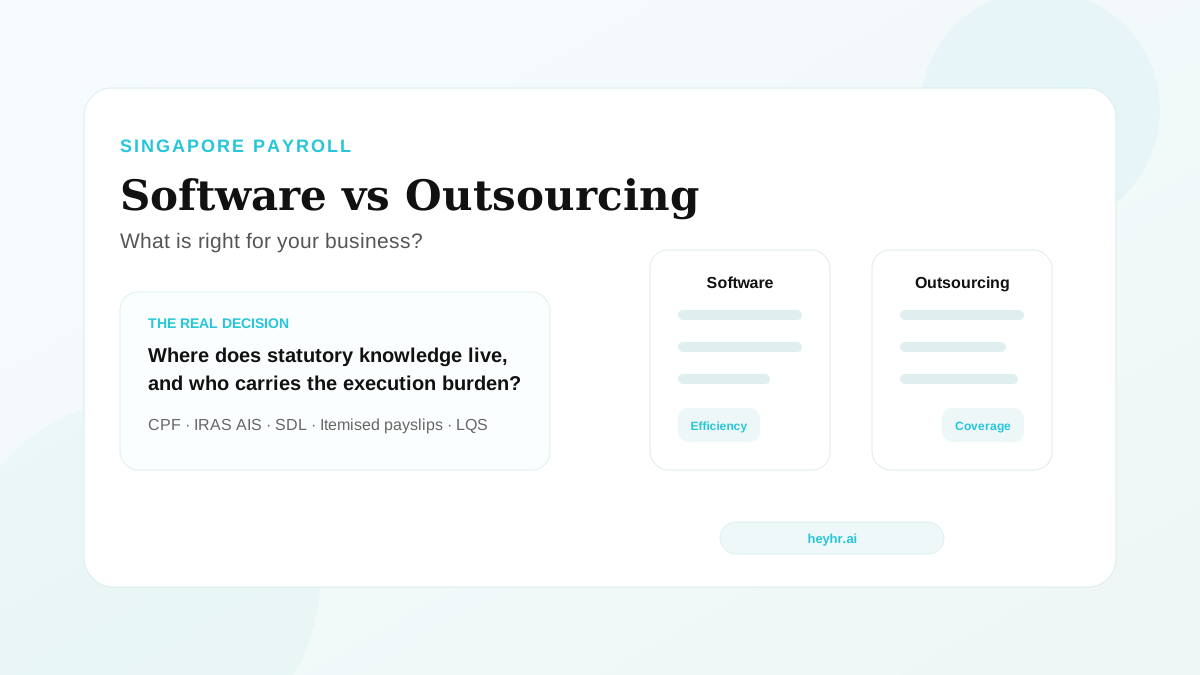
- In Singapore, payroll is not only salary processing. It is where statutory rules and workflow execution meet.
- Outsourcing often covers more real-world payroll work, but with higher coordination cost and weaker internal visibility.
- Software improves efficiency, yet often leaves statutory interpretation and exception handling outside the system.
- The deeper gap is the need to unify payroll knowledge and payroll execution in one operating model.
Choosing a payroll solution in Singapore may sound like a simple operational decision. For many businesses, it begins with a practical question: should payroll be managed through software in-house, or outsourced to a provider?
But payroll in Singapore is not just salary processing. It sits at the intersection of statutory rules and operational execution. Employers need to calculate pay correctly, but they also need to stay aligned with CPF requirements, IRAS reporting obligations, itemised payslips, Skills Development Levy, and, in some cases, workforce-linked thresholds such as the Local Qualifying Salary. In practice, payroll is both a compliance function and a workflow function.
That is why choosing a payroll solution is not only about convenience. It is also about deciding how statutory knowledge and execution should work together inside the business.
A brief note on how Singapore payroll works
Singapore payroll is often described as if it were mainly about monthly salary calculation. In reality, the work is broader. Employers may need to apply CPF rules correctly, maintain payroll records, issue itemised payslips, account for SDL, and prepare for IRAS reporting through AIS where applicable.
In 2026, that also means keeping pace with the CPF Ordinary Wage ceiling reaching S$8,000, the senior worker CPF contribution rate increases from 1 January 2026, and the full-time Local Qualifying Salary rising to S$1,800 from 1 July 2026. [SG1][SG2][SG3][SG4]
So when companies compare payroll solutions, they are not really comparing only tools. They are comparing operating models.
The main options: payroll outsourcing and payroll software
In most cases, companies in Singapore choose between two main models: payroll outsourcing and payroll software.
With payroll outsourcing, an external provider handles much of the payroll process on the company’s behalf. With payroll software, the company uses a system internally and manages payroll more directly. Some businesses also operate in a hybrid way, using software internally while relying on an external provider for specific support or filings. But in substance, the market still revolves around these two main options.
At a high level, the distinction seems simple. One relies more on people and service. The other relies more on systems and automation.
But the deeper distinction is this: where does the statutory knowledge live, and who carries the burden of execution?
Payroll outsourcing: broader in scope, but costly over time
Payroll outsourcing often covers a broader operational scope than many software systems.
That is one reason it remains attractive, especially for smaller companies or teams without strong in-house HR or payroll expertise. A service provider may help with recurring payroll runs, exceptions, documentation, filing support, and practical handling of issues as they arise. In that sense, outsourcing often solves not only payroll processing, but also part of the operational burden around payroll.
This matters because payroll is rarely clean and repetitive in real life. Questions arise. Exceptions appear. New joins, resignations, variable pay items, and unusual cases all require attention. Manual service models can often absorb these realities better than basic software tools.
But outsourcing comes with its own cost structure.
The obvious cost is the service fee. The less obvious cost is communication. Information moves back and forth through emails, spreadsheets, attachments, calls, and clarifications. Context may sit with the external provider, with one internal HR person, or in fragmented message trails. Over time, this creates delays, repeated coordination, weaker visibility, and information leakage across people and systems.
So while outsourcing may reduce execution burden, it can also increase the cost of coordination and leave payroll knowledge outside the company.
Payroll software: more efficient, but often narrower than expected
Payroll software is usually presented as the more modern option. And in many ways, it is.
Software can make payroll faster, cleaner, and more scalable. It can improve records, standardise workflows, generate payslips, and support structured submissions. IRAS also maintains a list of AIS-compatible payroll software vendors, which shows that software capability has become part of the practical Singapore payroll landscape. [SG2]
But payroll software also has a limit that is often overlooked.
Ironically, what looks more advanced is often narrower in scope. Many payroll software systems streamline execution, but leave much of the statutory knowledge and exception handling outside the system.
In other words, software can automate payroll runs without truly absorbing the logic that makes payroll difficult. The system may calculate, but the team still has to interpret rules, configure exceptions, manage edge cases, and ensure that changing requirements are properly reflected. That means the business may gain efficiency while still carrying much of the real payroll complexity outside the product.
This is why many companies discover that software alone does not fully replace operational dependency. It simply shifts the boundary.
The real gap: payroll needs both knowledge and execution
This is the long-standing gap in payroll.
Outsourcing helps reduce execution burden, largely through people. Software helps improve execution efficiency, largely through automation. But neither model fully solves the deeper need on its own: payroll requires both statutory knowledge and reliable execution, working together in the same system.
That includes understanding local rules, applying them correctly, handling exceptions, maintaining consistency over time, and making outcomes visible enough for teams to trust and verify them. The real need has never been just faster payroll. It has been a more complete payroll operating model.
A new option is increasingly needed
For a long time, businesses have had to choose between two imperfect answers.
One option was software that automated parts of payroll but left too much knowledge outside the system. The other was outsourced service that covered more of the real work, but with higher cost, slower communication, and less internal visibility.
This is where HeyHR comes in.
At HeyHR, we believe the long-standing need in payroll has not simply been better validation, smarter calculation, or more automation layered onto old workflows. The deeper need has been for a system that can bring payroll knowledge, payroll execution, and the surrounding HR operations together in one environment.
That is what makes an AI-native approach meaningful.
In our view, AI-native payroll should not mean a slightly smarter payroll engine or a more convenient assistant sitting on top of existing software. It should mean a system that can support true end-to-end payroll and HR operations in a way that HR teams and employees can use without having to fundamentally change how everyday work gets done.
In other words, the goal is not only to automate payroll runs. It is to make more of the real payroll and HR work — including the knowledge-heavy, exception-driven, and operationally fragmented parts — part of the system itself.
Global payroll companies such as ADP and others play an important role in the market, especially for large organisations. But in deeply localised payroll environments like Singapore, there has long been room for a more adaptive model: one that can better reflect local statutory logic, company-specific workflows, and operational complexity within the product itself. Singapore’s payroll environment remains shaped by local CPF rules, IRAS reporting structures, and MOM-linked employment requirements, which is exactly why localisation matters so much. [SG1][SG2][SG3][SG4]
That is the direction HeyHR is built around — not simply software for running payroll, and not service wrapped in software, but a more intelligent payroll model that aims to unify statutory knowledge, execution workflow, and operational visibility in a way that feels natural to the people who actually use it.
Who should care most about this model?
This kind of model is especially relevant for three types of organisations.
The first is SMEs with limited in-house HR or payroll knowledge. These businesses often find pure outsourcing expensive over time, but also find that ordinary payroll software expects too much internal expertise.
The second is multi-entity or multi-country organisations. As soon as payroll spans more than one entity or jurisdiction, consistency, visibility, and operational control become much harder to maintain across systems and providers.
The third is organisations with diverse workforce structures. Complexity does not come only from company size. It also comes from different pay cycles, different contract types, and different worker categories. A business may have wage-based employees, monthly salaried staff, consultants, lawyers, or other professionals with different arrangements. That kind of diversity quickly exposes the limits of narrow payroll tools and overly manual service models.
Payroll software versus payroll outsourcing is still a valid question. But it is no longer the full question.
For growing businesses in Singapore, the more important issue is how payroll knowledge, payroll execution, and day-to-day HR operations come together. The next generation of payroll solutions will be defined by whether the system can carry more of the real work of payroll and HR itself — end to end, with less fragmentation, less dependency on manual coordination, and far better operational continuity.
Sources
Official references relevant to this article.
- SG1. CPF Board — Changes to the CPF contribution rates for senior workers from 1 January 2026.
cpf.gov.sg — CPF contribution rate changes - SG2. IRAS — Auto-Inclusion Scheme (AIS) for Employment Income.
iras.gov.sg — AIS for Employment Income - SG3. Ministry of Manpower — Local Qualifying Salary.
mom.gov.sg — Local Qualifying Salary - SG4. CPF Board — How much CPF contributions to pay.
cpf.gov.sg — CPF contribution amounts - SG5. IRAS — Reporting employee earnings (IR8A, Appendix 8A, Appendix 8B).
iras.gov.sg — IR8A reporting - SG6. Ministry of Manpower — Itemised payslips.
mom.gov.sg — Itemised payslips - SG7. CPF Board — Skills Development Levy.
cpf.gov.sg — Skills Development Levy
Thinking about software vs outsourcing for Singapore payroll?
Talk to us about building a more practical payroll operating model for your team.
Contact Us